This piece reflects the author's opinion, not news reporting.
The General Manager Who Can't Be Fired
Why Jerry Jones Is the Cowboys' Biggest Accountability Problem
Thirty years without an NFC Championship Game. Countless changes at quarterback, head coach, and across the roster. Yet the man ultimately responsible for building the Dallas Cowboys remains untouchable.
CowRant Staff · Nov 3, 2026 · 7 min read
There is one job in professional football where three decades without reaching a conference championship might not cost you your position.
General manager of the Dallas Cowboys.
Not because the results have been good enough. Not because the franchise has consistently competed for championships. And certainly not because the fans are satisfied.
It's because the general manager owns the team.
Jerry Jones cannot be fired by Jerry Jones.
And that might be the single biggest problem facing America's Team.
Thirty Years of Excuses. One Constant.
The Dallas Cowboys last played in the NFC Championship Game following the 1995 season.
Think about how much has changed since then.
Troy Aikman retired. Emmitt Smith retired. Michael Irvin retired.
The Cowboys moved into a spectacular new stadium. They built a world-class training facility in Frisco. They became one of the most valuable sports franchises on the planet.
They've had different head coaches, different franchise quarterbacks, different coordinators, and generations of talented players.
Yet the championship drought continues.
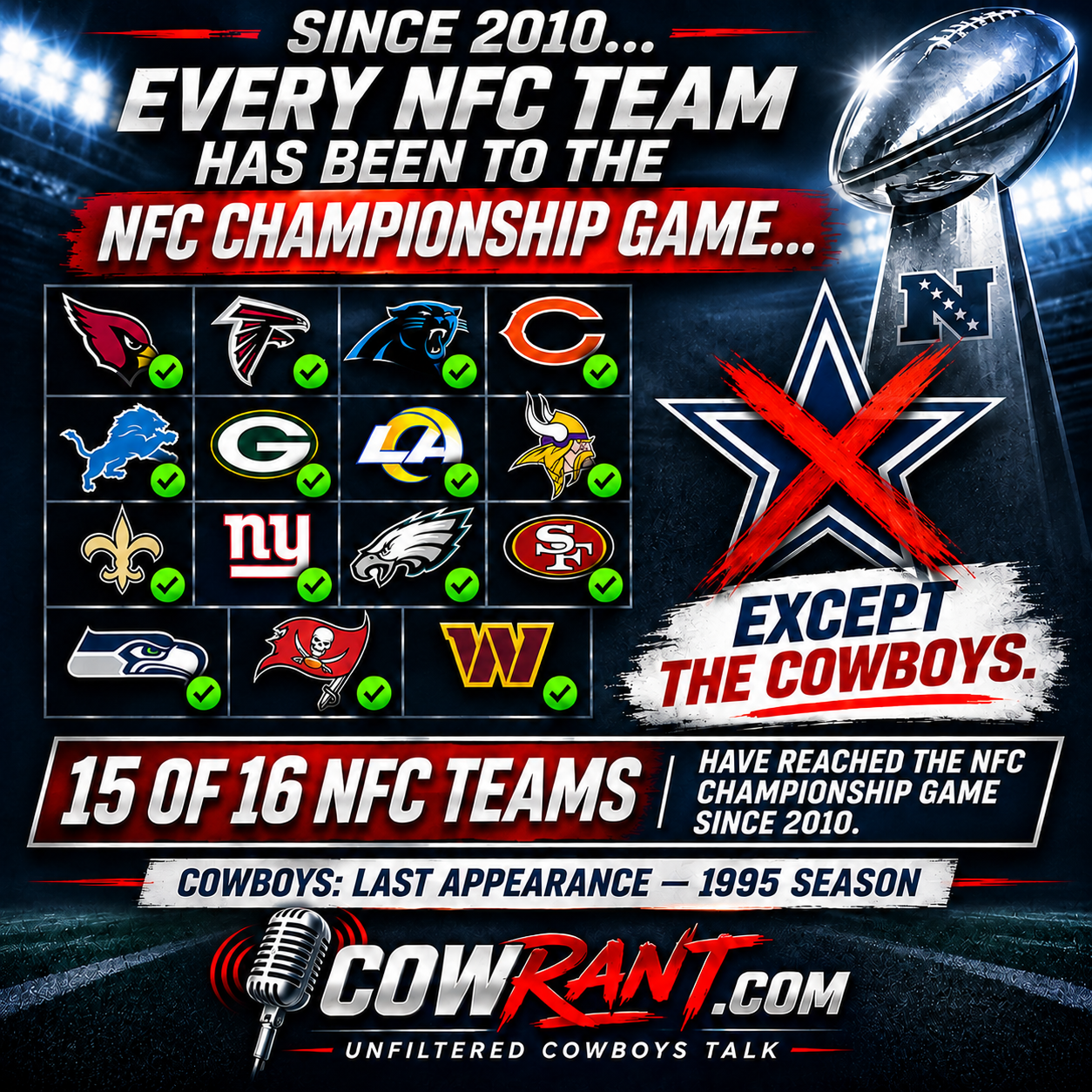
Since the 2010 NFL season, every other NFC franchise has reached the conference championship game.
Fifteen teams. Fifteen different opportunities to play for the NFC title. And Dallas is the only one missing.
That's not a single bad season.
That's a pattern.
And when a pattern continues through different coaches, quarterbacks, and rosters, it's reasonable to examine the people making the decisions.
The One Person Who Never Faces the Consequences
In most NFL organizations, the chain of command is straightforward.
The head coach answers to the general manager. The general manager answers to ownership.
If the team repeatedly fails to meet expectations, the owner can replace the people responsible for football operations.
Dallas is different.
Jerry Jones has served as the Cowboys' owner, president, and general manager since purchasing the franchise in 1989.
That means the person evaluating the general manager's performance is also the general manager.
Imagine running any other multibillion-dollar organization this way.
A division repeatedly falls short of its primary objective. Executives are replaced. Employees come and go. Strategies change.
But the executive in charge of the division keeps the job indefinitely because he owns the company.
That's not accountability.
That's job security.
And Cowboys fans have spent three decades watching the consequences.
Give Jerry Credit for What He Built
To criticize Jerry Jones fairly, we have to acknowledge what he accomplished.
Under his ownership, the Cowboys won three Super Bowls following the 1992, 1993, and 1995 seasons.
He helped transform the franchise into a global sports and entertainment powerhouse.
He has been a major force in NFL marketing, television, sponsorships, and stadium development.
Those accomplishments matter.
Jerry Jones deserves recognition as one of the most influential owners in professional sports history.
But being a brilliant owner and businessman does not automatically make someone the best person to run football operations.
Those are different jobs requiring different forms of expertise.
And the Cowboys' inability to return to the NFC Championship Game raises a question that no amount of business success can answer:
If the football operation has fallen short for thirty years, why is its leadership structure still effectively untouchable?
The Cowboys Aren't Short on Talent
One of the most frustrating parts of this drought is that Dallas hasn't spent thirty years fielding hopeless teams.
The Cowboys have won division championships.
They've produced Hall of Fame players, Pro Bowlers, elite offensive lines, and some of the NFL's most recognizable stars.
They've posted outstanding regular-season records.
Consider the 2007 and 2016 teams. Both finished 13–3.
Or the three consecutive 12-win seasons from 2021 through 2023.
Those weren't teams without talent.
Yet none reached the NFC Championship Game.
That doesn't mean every playoff loss was the general manager's fault. Coaches make mistakes. Players make mistakes. Opponents sometimes simply play better.
But building a championship organization is about more than assembling talented players.
It's about constructing a roster that can survive the postseason, hiring the right coaching staff, managing resources, and making difficult decisions before weaknesses become fatal.
The general manager bears significant responsibility for those decisions.
Unless, apparently, the general manager is also the owner.
The Problem With Being the Biggest Personality in the Building
The Dallas Cowboys have never lacked attention.
Every major roster decision becomes a national headline. Every contract negotiation becomes a public debate. Every disappointing season becomes another chapter in the Jerry Jones story.
That's part of what makes the Cowboys commercially successful.
But it also creates a legitimate concern.
Can a football organization establish clear authority when its owner is also its general manager, president, and most visible spokesperson?
A head coach needs the freedom to lead.
A general manager needs the authority to make difficult personnel decisions.
Players need to understand who establishes expectations and who enforces them.
When so much organizational power and public attention revolves around one individual, those lines can become blurred.
That doesn't prove every Cowboys failure comes from Jerry Jones.
But it does make the structure itself worthy of scrutiny.
And after three decades, scrutiny is long overdue.
The Difference Between Winning the Business and Winning the Football
The Cowboys' business success is extraordinary.
Their championship results over the last three decades are not.
Both statements can be true.
In 2026, Sportico valued the Cowboys at approximately $15.5 billion, placing them at the top of its NFL franchise rankings.
That's a staggering business accomplishment.
But fans don't spend Sundays cheering for franchise valuations.
They don't buy jerseys to celebrate sponsorship revenue.
And they certainly don't dream about lifting a trophy for having the NFL's most valuable brand.
They want to win football games.
More specifically, they want to see the Dallas Cowboys compete for championships again.
The Cowboys have mastered the business of being America's Team. They haven't mastered the business of returning to the Super Bowl.
And the longer the drought continues, the harder it becomes to separate those two realities.
What Would Real Accountability Look Like?
The answer isn't necessarily for Jerry Jones to sell the Cowboys.
He owns the franchise. That's his right.
The question is whether he should continue serving as its general manager.
A meaningful structural change would involve hiring an empowered football executive with genuine authority over personnel decisions, roster construction, and long-term strategy.
Ownership would establish expectations and provide resources.
Football leadership would be responsible for meeting those expectations.
And if the results consistently fell short, leadership would change.
That's how accountability is supposed to work.
There is no guarantee that hiring a separate general manager would immediately deliver a Super Bowl.
But it would address an obvious conflict in the Cowboys' current structure: the person responsible for evaluating the football operation is the same person ultimately running it.
The Question Jerry Jones Needs to Answer
Jerry Jones has often spoken about his desire to win another Super Bowl.
There's no reason to dismiss that desire.
But wanting to win and creating the best possible structure to win are not necessarily the same thing.
At some point, commitment has to be measured by a willingness to change.
And that leads to the question Cowboys fans should be asking:
If Jerry Jones didn't own the Dallas Cowboys, would Jerry Jones still be their general manager after thirty years without an NFC Championship appearance?
It's difficult to imagine another owner accepting that record indefinitely without reconsidering the position.
That's what makes Dallas different.
And that's why this isn't simply another argument about a disappointing season.
It's an argument about accountability.
The Cowboys have changed nearly everything over the last thirty years.
Except the one position that might need changing most.
Love the Team. Question the Culture.
Join the Rant
Should Jerry Jones step aside as general manager and hire an independent football executive with real decision-making authority? Or do you believe he remains the right person to lead the Cowboys' football operations?
Tell us what you think